

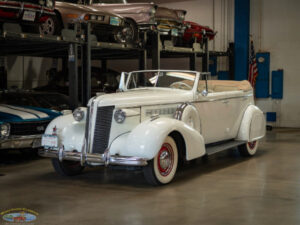
Introduced in the 1930s as Buick’s flagship full-size luxury offering, the Buick Roadmaster quickly set the benchmark for prestige, engineering innovation, and highway comfort. Whether speaking of the flowing pre-war coupes, the legendary postwar straight-eight chrome cruisers, the jet-age convertibles of the 1950s, or the beloved 1990s LT1-powered estate wagons, the Roadmaster represents one of the most coveted vintage nameplates for classic car collectors nationwide.
Below is an essential buyer and seller guide outlining the specifications, build data, and rich history of the Buick Roadmaster.
Production Numbers
Throughout its storied lifecycle across eight generations (1936–1942, 1946–1958, and the 1991–1996 revival), production numbers varied significantly depending on body style and post-war manufacturing shifts:
- First Generation (1936–1937): Approximately 16,129 units sold in its inaugural year, signaling an instant triumph for Buick’s revised lineup.
- Pre-War Era (1938–1942): Annual figures averaged between 5,500 and 15,300 units, curtailed sharply when civilian automobile manufacturing paused in early 1942 for wartime defense efforts.
- Post-War Boom (1946–1953): Production soared alongside economic prosperity. The Roadmaster’s share of total Buick sales jumped to 20% in 1946 (~31,400 units), eventually peaking with landmark years like 1950 (over 70,000 units across sedan and coupe variants) and 1953 (79,137 total units).
- Estate Wagons: Historically among the rarest Roadmasters built. The wooden-bodied “Woodie” wagons from 1947 to 1953 regularly saw annual builds between just 350 and 680 units, making surviving examples exceptionally valuable today.
- Eighth Generation Revival (1991–1996): Buick produced roughly 225,000 units total across both the four-door sedan and the wood-paneled Estate Wagon prior to GM discontinuing the rear-wheel-drive B-body platform.
Color Combinations
The Roadmaster embraced General Motors’ most daring styling palettes, transitioning from deep pre-war lacquers to two-tone post-war pastels:
- Classic & 1950s Exterior Tones: Shell Grey, Terrace Green, Majestic White, Victoria Maroon, Jordan Grey, Glacier Blue, Verde Green, Imperial Blue, and Mandarin Red.
- Two-Tone Factory Pairings: Mid-century models frequently paired contrasting roof and body selections—such as Shell Grey over Tyler Blue, Majestic White over Reef Blue, or Terrace Green over Ridge Green.
- Interior Schemes: Finished in premium wool broadcloth, ribbed nylon fabrics, two-tone genuine leathers (especially on Skylark/convertible packages), and later, plush velour and leather seating surfaces matched to burgundy, sapphire blue, neutral beige, and emerald tones.
- Accent Features: Real mahogany and ash wood framing on early Estate Wagons, accompanied by gleaming engine-turned dashboards and signature exterior chrome sweeping down the body sides.
Engine Type
The Roadmaster carried some of GM’s most celebrated powertrains:
- Dynaflash / Fireball Straight-8 (1936–1952): A legendary 320.2 cu. in. (5.2-liter) overhead-valve inline-eight engine. Renowned for its buttery-smooth idle, high torque delivery, and distinctive exhaust note, producing between 130 hp and 170 hp with compound carburetion or 4-barrel carburetors.
- Nailhead V8 (1953–1958): Buick’s modern overhead-valve V8 debuted in 1953 with a 322 cu. in. (5.3L) displacement, eventually expanding to 364 cu. in. (6.0L) by 1957, delivering up to 300 horsepower.
- Modern Small-Block V8s (1991–1996): Initial models utilized the 5.0L and 5.7L L05 throttle-body injected V8 (180 hp), replaced in 1994 by the high-performance 5.7L LT1 V8 shared with the Corvette and Impala SS, tuned to 260 horsepower and 330 lb-ft of torque.
Transmission
- 3-Speed Manual: Early Roadmasters (1936 to late 1940s) used a heavy-duty 3-speed sliding-shift or synchromesh manual gearbox with floor and later column-mounted shifters.
- Dynaflow Automatic: Introduced in 1948, the 2-speed torque-converter Dynaflow became synonymous with Buick. It provided uninterrupted acceleration without perceptible gear shifts, setting a new luxury benchmark across the industry.
- 4-Speed Overdrive Automatics: The modern 1990s generation utilized the robust GM 4L60 and electronically controlled 4L60-E automatic transmissions, tailored for effortless long-distance cruising.
Additional Stats
- Wheelbase: 129.0 to 131.0 inches (vintage C-body models); 115.9 inches (1990s B-body models).
- Overall Length: Stretched up to 215–219 inches—truly full-sized American grand touring proportions.
- Curb Weight: 4,200 to 4,700 lbs depending on trim and body style.
- Towing Capacity: Up to 5,000 lbs on 1990s LT1 wagons equipped with factory heavy-duty towing packages.
- Key Visual Cues: Iconic front-fender VentiPorts (introduced in 1949), full-length chrome Sweepspear moldings, and the legendary waterfall grille.
Detailed Car Description
The Buick Roadmaster was designed under legendary GM styling chief Harley Earl to be the commanding ruler of the open highway. Debuting as the Series 80 in 1936 and transitioning to the flagship Series 70, the Roadmaster showcased dramatic streamlining, wide torpedo-style sheet metal, and commanding presence.
Beyond styling, the Roadmaster served as Buick’s technological trailblazer. It popularized rear coil-spring suspension over traditional leaf springs, introduced torque-tube drive setups, and debuted the iconic VentiPort fender vents, which remain an enduring hallmark of Buick design. Inside, passengers were treated to opulent deep-cushioned bench seating, acoustic dampening, art-deco dashboard instrumentation, and expansive glass canopies.
In modern classic collector circles, the Roadmaster enjoys widespread acclaim across all its eras. The post-war Sedanet fastbacks and Riviera two-door hardtops represent the pinnacle of mid-century automotive art, while the 1990s LT1 Estate Wagons have achieved true cult status among vintage enthusiasts who appreciate high-output torque wrapped in unmistakable woodgrain nostalgia.
Ready to Sell Your Classic Buick Roadmaster?
If you have a vintage Buick Roadmaster or other kind of classic American car sitting in your garage, collection, or estate, finding a trusted buyer who recognizes its authentic heritage and true collector value is crucial. Get a seamless evaluation, transparent valuation, and immediate payment from experienced vintage automobile specialists who handle everything from nationwide transportation to title paperwork with complete ease. Submit your vehicle details online today for a fast, no-obligation cash appraisal!