
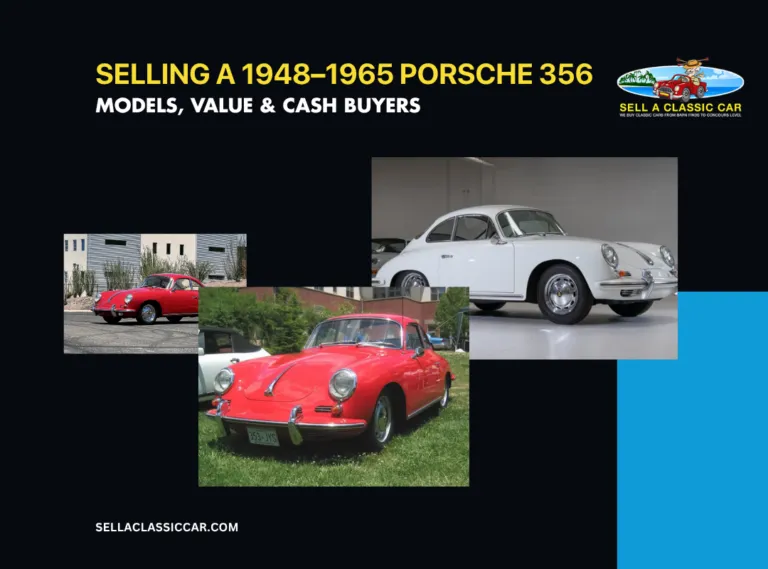
When considering the history of sports cars, few models carry the heritage of the Porsche 356. Produced from 1948 through 1965, the 356 was Porsche’s very first production automobile. Its rear-engine layout, lightweight unibody construction, and aerodynamic silhouette established the design philosophy that eventually gave birth to the Porsche 911. Today, the Porsche 356 remains one of the most blue-chip collectible German cars in existence.
If you own a 1948–1965 Porsche 356, have inherited an estate vehicle, or are looking to liquidate a long-held collection, understanding its true market value is vital. Depending on the generation, coachbuilder, body style, and originality, Porsche 356 values span from $45,000 for barn-find projects to over $500,000+ for rare, numbers-matching Speedsters and Four-Cam Carrera models.
At Sell A Classic Car, we take the guesswork out of selling a Porsche 356 as well as other vintage sports cars. We provide direct cash offers, seamless DMV paperwork handling, and nationwide white-glove transport. Here is a comprehensive guide to evaluating your vintage Porsche 356 and securing a top cash payout.

Porsche 356 Generations & Model Variants
Porsche continuously refined the 356 platform over its 17-year production run. To determine what your car is worth, it helps to understand the four primary production eras and how collector demand shifts between them.
1. Porsche 356 “Pre-A” (1948–1955)
Built initially in Gmünd, Austria, and later in Zuffenhausen, Germany, the earliest 356 models are commonly referred to as “Pre-A.” Characterized by their split-windshield (1948–1952) or bent-windshield (1952–1955) designs, these cars feature minimal trim, tele-dial instrument clusters, and early air-cooled flat-four engines ranging from 1.1L to 1.5L. Due to low production numbers, intact Pre-A models command a significant premium among high-end collectors.
2. Porsche 356A (1955–1959)
Introduced in late 1955 for the 1956 model year, the 356A brought significant technical overhauls, including a curved single-piece windshield, updated suspension geometry, and the option of 1300cc, 1600cc, or high-performance 1600 Super engines. This era also popularized the iconic 356A Speedster—a stripped-down, lightened variant built specifically to capture the booming U.S. sports car market.
3. Porsche 356B (1959–1963)
The 356B brought noticeable exterior body revisions designed to meet U.S. safety standards, including raised front bumpers, higher headlights, and dual air-intake grilles on the engine lid (for later T6 body styles). Available in “T5” (1959–1961) and “T6” (1962–1963) body designs, the 356B introduced the Super 90 engine option and offered exceptional drivability, making it one of the most accessible 356 models for vintage rallies.
4. Porsche 356C (1963–1965)
The final evolution of the series, the 356C featured standard four-wheel ATE disc brakes, refined interiors, and stronger engine variants—the 1600C (75 hp) and the high-output 1600 SC (95 hp). The 356C represents the mechanical pinnacle of the platform, combining vintage aesthetics with modern stopping power. Those are just a few of the cars that we want to buy.
Body Style Impact: Coupe vs. Cabriolet vs. Speedster / Roadster
In the Porsche collector world, body style plays an enormous role in overall valuation. Factory coachwork was handled by iconic bodybuilders like Reutter, Drauz, D’Ieteren, and Karmann.
- Coupes (Reutter & Karmann): The standard closed-roof models account for the majority of production. They serve as the benchmark for general 356 pricing.
- Cabriolets & Roadsters: Convertible models featuring full padded tops or low-profile windshields (Drauz/D’Ieteren Roadsters) carry a 30% to 60% price premium over equivalent coupes.
- Speedsters: Developed at the request of U.S. importer Max Hoffman, the bare-bones Speedster features a short bucket seat interior and low, removable windshield. Authentic Speedsters regularly fetch $250,000 to $500,000+ depending on provenance and condition.
Factors That Determine Your Porsche 356’s Worth
When our valuation team evaluates a 1948–1965 Porsche 356, we examine several core elements that influence fair market pricing:
1. Factory Kardex & Certificate of Authenticity (CoA)
Porsche meticulously documented every chassis produced on a factory build sheet known as a Kardex. Obtaining a Kardex or official Porsche CoA proves whether a car retains its original “matching numbers” engine case, transmission, exterior paint code, and optional equipment. A numbers-matching engine case stamp (located on the third piece of the engine crankcase) can elevate a 356’s value by tens of thousands of dollars.
2. Rust & Metalwork Integrity
Because early Porsche 356s lacked modern rust-proofing, structural corrosion is a common issue. Key areas inspected by buyers include:
- Floor pans and battery box structure
- Longitudinal chassis rails and jack spurs
- Heater channels and door bottoms
- Torsion bar tube mounts
Unrestored cars with original factory sheet metal (matching body stamped panels) command significant premiums over cars requiring heavy panel replacement.
3. Current Valuation Expectations for Selling a Porsche 356
| Condition Level | Description | Estimated Value Range |
|---|---|---|
| Project / Barn Find | Non-running, heavy rust, or incomplete restoration.[cite: 29] | $45,000 – $75,000[cite: 29] |
| Driver Quality | Mechanically sound, non-matching or period engine, minor cosmetic wear.[cite: 29] | $85,000 – $135,000[cite: 29] |
| Excellent / Restored | Correct matching numbers, high-quality restoration, fully sorted.[cite: 29] | $145,000 – $225,000[cite: 29] |
| Concours / Speedster | Rare factory Speedster, Carrera Four-Cam, or pristine award winner.[cite: 29] | $250,000 – $500,000+[cite: 29] |
How to Sell Your Porsche 356 to Sell A Classic Car (3 Simple Steps)
- Submit Vehicle Details: Call us at (310) 399-3990 or fill out our online submission form. Share basic details about your 356, including chassis number, engine number (if known), condition, and photos.
- Receive a Guaranteed Cash Offer: Our classic Porsche specialists analyze your vehicle against current market data to extend a fair, zero-obligation cash offer.
- Get Paid & Arrange Pickup: Upon agreement, funds are wired directly to your bank account or paid via cashier’s check. Once payment is confirmed, we organize enclosed carrier transport anywhere in the United States at no cost to you.
Frequently Asked Questions About Selling a Porsche 356
Do you purchase Porsche 356 barn finds or non-running project cars?
Yes. We buy Porsche 356 models in any condition—from pristine concours restorations to non-running garage finds, incomplete project cars, and rust restoration candidates.
What if my 356 has a non-matching or industrial engine?
It is very common for 356 models to have replacement engines or Volkswagen/industrial cases installed over their multi-decade lifespans. While matching-numbers engines command top dollar, we actively buy 356s with period-correct or non-matching drivetrains.
How does nationwide pickup work if I’m located outside of California?
Although our primary showroom is located in Southern California, we acquire classic vehicles across all 50 states. Once payment clears, our transport logistics team handles all vehicle loading and enclosed carrier shipping directly from your residence or storage facility.
Get an Immediate Cash Offer for Your Porsche 356 Today
In addition to cars like this, we also offer American cars for sale. Ready to discover the current market value of your 1948–1965 Porsche 356? Contact the experienced buyers at Sell A Classic Car.