

From launching the golden era of muscle cars with the 1964 GTO to creating pop-culture icons like the Firebird Trans Am and full-size luxury powerhouses like the Bonneville, vintage Pontiacs remain among the most sought-after collector cars nationwide.
Production Numbers:
Pontiac produced tens of millions of vehicles throughout its storied history (1926–2010), but production volume varied drastically across eras, nameplates, and special option packages:
- 1957 Pontiac Bonneville Convertible: 630 units (fuel-injected introductory run).
- 1962 Full-Size Pontiacs (Catalina, Bonneville, Star Chief, Grand Prix): 378,244 units total.
- 1964 Pontiac GTO: 32,450 units (7,384 coupes, 18,422 hardtops, and 6,644 convertibles).
- 1966 Pontiac GTO: 96,946 units (all-time single-year peak for the GTO nameplate).
- 1969 Pontiac Firebird Trans Am: 697 total units (689 hardtops, 8 convertibles).
- 1969 Pontiac GTO Judge: 6,833 units (6,725 hardtops, 108 convertibles).
- 1971 Pontiac GTO Judge: 374 units (357 hardtops, 17 convertibles).
- 1979 Pontiac Firebird Trans Am: 117,108 units (peak sales year of the second-generation body style).
Color Combinations:
Classic Pontiacs were celebrated for vibrant two-tone lacquer finishes in the 1950s and bold high-impact hues during the muscle era. Popular factory exterior shades and interior pairings included:
- Starlight Black: Paired with Gold striping and black interior (made iconic on the Y82/Y84 Special Edition Trans Am).
- Carousel Red: Exclusive high-impact orange/red hue paired with parchment, black, or blue interior (standard launch color for the 1969 GTO Judge).
- Cameo White: Often matched with Lucerne Blue stripes, Tyrolean Blue accents, or blue vinyl interior on Firebirds and Trans Ams.
- Fontana Red & Montero Red: Classic deep reds paired with black or white Morrokide bucket seating.
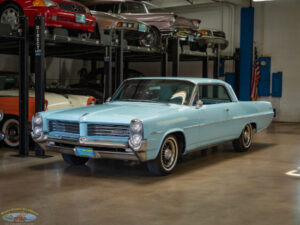
- Lucerne Blue & Admiralty Blue: Ranging from light metallic blue to deep navy, frequently paired with matching dark blue or light buckskin vinyl.
- Tropical Lime & Orbit Orange: Rare 1970–1971 high-impact exterior tones paired with dark sandalwood or black interiors.
- Two-Tone 1950s Finishes: Combinations such as Tartan Turquoise with Dover White, or Kenya Copper over Sandstone Beige, matched with two-tone cloth and Morrokide interiors.
Engine Type:
Unlike other GM divisions that relied on separate small-block and big-block architectures, vintage Pontiac V8 engines (produced from 1955 to 1981) were built on a single, shared external block footprint:
- Early V8s & Straight-Eights: 239.2 to 268.4 cu in L-head straight-eights (pre-1955), followed by the 287 and 316 cu in Strato-Streak overhead-valve V8s.
- 389 cu in Trophy V8 (6.4L): Available with single four-barrel carburetion (325–348 hp) or the legendary Tri-Power setup (three 2-barrel Rochester carburetors) rated up to 360 hp.
- 421 cu in Super Duty & Trophy V8 (6.9L): High-output street and drag-racing engines developing up to 405 hp with dual 4-barrel carbs.
- 400 cu in V8 (6.6L): The core muscle powerplant powering the GTO, Firebird, and Grand Prix, available in standard, H.O., Ram Air III (366 hp), and Ram Air IV (370 hp) configurations.
- 455 cu in & 455 H.O. / Super Duty (7.5L): Massive displacement torque monsters producing up to 335 gross hp and 480 lb-ft of torque, featuring heavy-duty round-port cylinder heads.
- Inline-Six Options: 230 and 250 cu in Overhead Cam (OHC) “Sprint Six” engines with four-barrel carburetors and free-revving valvetrains.
Transmission:
Pontiac paired its torquey engines with a versatile array of manual and automatic transmissions engineered to handle heavy torque output:
- 3-Speed Manual: Standard column-shift and floor-shift transmissions (heavy-duty Borg-Warner or Dearborn units on high-performance models).
- 4-Speed Manual: Muncie M20 (wide-ratio), M21 (close-ratio), and heavy-duty M22 “Rock Crusher” gearboxes equipped with factory Hurst floor shifters.
- Super Hydra-Matic / Dual-Path: Early 2-speed and 4-speed controlled-coupling automatic gearboxes used throughout the late 1950s and early 1960s.
- Turbo Hydra-Matic (TH350 & TH400): Durable 3-speed automatics introduced in the mid-1960s, paired with optional Hurst Dual-Gate “His and Hers” console shifters on models like the GTO.
Additional Stats:
- Chassis Architecture: Body-on-frame platform for A-body (GTO, LeMans, Tempest) and B-body (Catalina, Bonneville, Grand Prix), with unitized front subframe design on F-body (Firebird).
- Wheelbase: 108 inches (Firebird), 115 inches (GTO 2-door), 120–121 inches (Grand Prix), and 123.5–127 inches (Bonneville/Catalina full-size).
- Curb Weight: 3,300 lbs (Firebird 400) to 4,450 lbs (Bonneville hardtop sedan).
- Brakes: Front and rear hydraulic drums; front disc brakes became optional in 1967 and standard on performance variants by 1970.
- Rear Axle: Pontiac 10-bolt and heavy-duty 12-bolt differentials equipped with optional Safe-T-Track limited-slip differentials.
- Performance Benchmarks (1965 GTO 389 Tri-Power): 0–60 mph in 5.8 seconds; quarter-mile in 14.5 seconds at 100 mph.
Detailed Car Description:
Pontiac earned its legendary reputation by combining striking design with accessible American horsepower. In 1959, Pontiac introduced the “Wide-Track” stance—pushing the wheels further outward toward the fenders to enhance cornering stability and give the cars an aggressive road posture.
By 1964, Pontiac engineer John DeLorean and his team dropped a full-size 389 cu in V8 into the mid-size Tempest LeMans, circumventing GM’s corporate engine displacement caps and birthing the GTO—the vehicle widely recognized as launching the American muscle car movement. Stylistically, Pontiac stood apart from its siblings with distinctive split front grilles, hood-mounted tachometers, functional Ram Air scoops, body-colored Endura front bumpers, and flush taillights.
Whether it is a tri-power Bonneville cruising boulevard strips or a Firebird Trans Am tearing up highway asphalt, classic Pontiacs embody the pinnacle of 20th-century Detroit automotive engineering.
Sell Your Classic Pontiac Today
If you have an original, restored, or barn-find vintage Pontiac (or other American car) in your garage or collection, find out what it is worth in today’s active collector market. Submit your vehicle details, year, and photos through our online valuation request form to receive a prompt, no-obligation cash appraisal and nationwide purchase offer.