
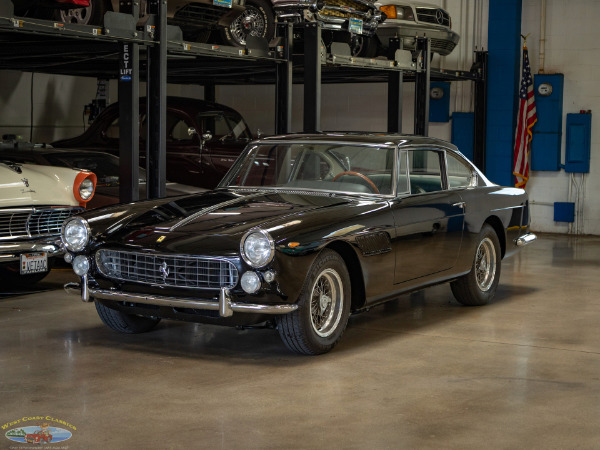
1963 Ferrari 250 GT
The 1963 Ferrari 250 GT represents the pinnacle of Maranello’s golden era of dual-purpose road and track engineering. In 1963, the Ferrari 250 GT lineup spanned several distinct, hand-built models—most notably the 250 GT/L Berlinetta Lusso, the 250 GT/E 2+2 (Series III), the final examples of the 250 GT SWB California Spyder, and the legendary 250 GTO.
Designed primarily by Pininfarina and bodied by Scaglietti or Pininfarina, these grand tourers combined Gioacchino Colombo’s race-bred V12 architecture with refined Italian coachwork.
Production Numbers
Because Ferrari built the 250 GT in low-volume, coachbuilt runs rather than mass-production assembly lines, total output across the 1963 variants remained strictly limited:
- 1963 Ferrari 250 GT/L Berlinetta Lusso: 350 total units produced across its entire 1962–1964 production run.
- 1963 Ferrari 250 GT/E 2+2: 954 total units built between 1960 and 1963 across three series, making it Ferrari’s most commercially successful 250 model. (The final 50 cars built at the end of 1963 transitioned to the 4.0-liter engine as the 330 America.)
- 1963 Ferrari 250 GT SWB California Spyder: Only 56 examples were constructed between 1960 and 1963, with the final units completed in early 1963.
- 1963 Ferrari 250 GTO: Just 36 original cars manufactured between 1962 and 1964 (33 with Series I bodywork built in 1962–1963, and 3 with Series II bodywork in 1964).
Color Combinations
During 1963, Ferrari did not restrict buyers to a rigid, standardized paint palette; instead, clients frequently commissioned bespoke exterior and interior pairings through Pininfarina and Scaglietti.
While Rosso Corsa (racing red) is the color most commonly associated with modern Ferraris, 1963 250 GT grand tourers were predominantly delivered in understated metallic hues and rich, earthy tones paired with Connolly Vaumol leather interiors.
- Popular Factory Exteriors: Grigio Argento (silver-gray), Blu Sera (deep evening blue), Amaranto (dark maroon), Nero (black), Bianco (white), and Verde (dark metallic green).
- Signature Connolly Leather Interiors: Nero (black), Cuoio (saddle tan), Beige, Rosso (red), and Verde (green).
- Collector Impact: Matching-numbers examples that retain—or have been restored to—their original factory build-sheet colors (verified via a Ferrari Classiche Red Book or Marcel Massini history report) command significant premiums on the collector market.
Engine Type
Every 1963 Ferrari 250 GT is powered by an iteration of the iconic 3.0-liter (2,953 cc) Colombo 60-degree V12. Named after designer Gioacchino Colombo—and designated “250” because each individual cylinder displaces roughly 250 cc—this all-aluminum, single-overhead-camshaft (SOHC) powerplant features two valves per cylinder and a 73 mm x 58.8 mm bore and stroke.
- 250 GT/E 2+2 & California Spyder (Tipo 128E / 168): Equipped with three twin-choke Weber 40 DCL6 or 36 DCS carburetors and an 8.8:1 compression ratio, producing 240 horsepower at 7,000 rpm.
- 250 GT/L Lusso (Tipo 168U): Upgraded with single-ported cylinder heads borrowed from Ferrari’s competition models and three Weber 36 DCS carburetors, rated between 240 and 250 horsepower at 7,000–7,500 rpm.
- 250 GTO (Tipo 168 Comp/62): Fitted with dry-sump lubrication, a 9.7:1 compression ratio, and six twin-choke Weber 38 DCN carburetors, generating 296 to 300 horsepower at 7,500 rpm.
Transmission
- Standard Grand Touring Gearbox (Lusso, GT/E, California Spyder): A 4-speed all-synchromesh manual transmission paired with a single dry-plate clutch. On the 250 GT/E 2+2, Ferrari included an electrically actuated Laycock de Normanville overdrive on fourth gear to enable effortless, high-speed European highway cruising.
- Competition Gearbox (250 GTO): A close-ratio 5-speed manual transmission engineered for rapid shifts on international endurance circuits.
Additional Stats
| Specification | 250 GT/L Berlinetta Lusso | 250 GT/E 2+2 (Series III) | 250 GT SWB California Spyder | 250 GTO |
|---|---|---|---|---|
| Wheelbase | 2,400 mm (94.5 in) | 2,600 mm (102.4 in) | 2,400 mm (94.5 in) | 2,400 mm (94.5 in) |
| Curb / Dry Weight | ~2,249 lbs (1,020 kg) | ~2,822 lbs (1,280 kg dry) | ~2,300 lbs (1,043 kg) | ~1,940–2,094 lbs (880–950 kg) |
| Top Speed | 145–150 mph | 143 mph (230 km/h) | 140 mph | 158–174 mph |
| 0–60 mph | ~7.0 seconds | ~7.5 seconds | ~7.0 seconds | ~5.4–6.1 seconds |
| Brakes | 4-wheel Dunlop discs | 4-wheel Dunlop discs | 4-wheel Dunlop discs | 4-wheel Dunlop discs |
Detailed Car Description
The 1963 Ferrari 250 GT sits at a historic crossroads in automotive design. Built on a tubular steel ladder frame with independent double-wishbone front suspension, a live rear axle with semi-elliptic leaf springs, and four-wheel Dunlop disc brakes, the 250 GT platform delivered balanced handling and stopping power far ahead of its contemporaries.
Visually, the 1963 models showcase Pininfarina’s mastery of proportion. The 250 GT/L Lusso—widely regarded as one of the most elegant road cars ever built—features sweeping fastback rooflines, slender chrome bumpers, an egg-crate front grille, and a panoramic rear window, paired with a leather-trimmed cabin highlighted by a central speedometer and tachometer angled toward the driver.
Meanwhile, the 250 GT/E 2+2 solved Enzo Ferrari’s personal desire for a four-seat V12 grand tourer by shifting the engine eight inches forward in the chassis, creating genuine rear seating without sacrificing Pininfarina’s sleek coupe silhouette.
Across every 1963 variant, hand-formed steel and aluminum body panels, Borrani wire wheels, and the unmistakable mechanical symphony of the Colombo V12 make the 250 GT a cornerstone of blue-chip classic car collecting.
Ready to Sell Your 1963 Ferrari 250 GT?
If you own a 1963 Ferrari 250 GT—whether a pristine matching-numbers Lusso, a well-documented 250 GT/E 2+2, or a long-term garage-stored project—Sell a Classic Car makes the selling process straightforward, transparent, and hassle-free.
Our team specializes in evaluating rare European sports cars and offers fair market valuations, immediate payment, and nationwide enclosed transport directly from your location. Visit Sell a Classic Car online today to submit your vehicle details and receive a complimentary, no-obligation offer.