
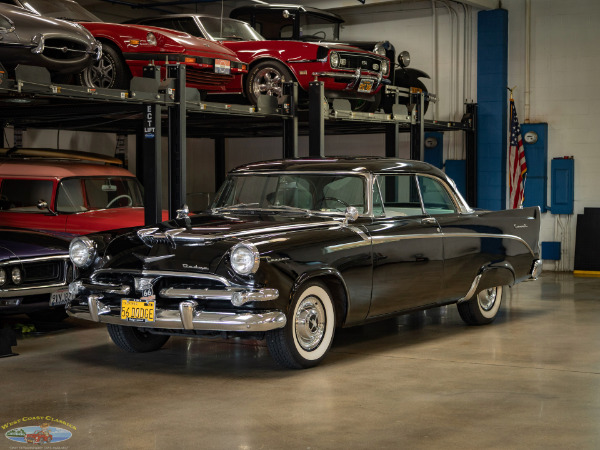
Dodge Coronet
Spanning seven generations from 1949 to 1976, the Dodge Coronet evolved from a conservative post-war family sedan into one of Mopar’s most sought-after B-body muscle cars before returning to its roots as a dependable mid-size cruiser.
Production Numbers
Because the Dodge Coronet remained in production across multiple decades (with a brief hiatus from 1960 to 1964), total output spans well over two million vehicles. However, collectors and buyers pay close attention to specific model years and low-production performance trims:
- First-Generation Launch (1949): Dodge built 193,036 Coronets in its debut year, including 48,646 two-door models and just 800 nine-passenger wood-bodied station wagons.
- 1950s Peak & Rarities: Annual production peaked in 1957 at 160,979 units across all body styles. Within that same year, Dodge produced just 101 high-performance D-501 coupes and convertibles.
- Fifth-Generation B-Body Era (1965–1970): Following its 1965 revival, standard trims like the Coronet 440 and 500 saw strong sales (exceeding 100,000 combined units in peak years like 1970), while performance models remained scarce. For example, only 296 Coronet R/T convertibles and 924 Coronet 500 convertibles were built in 1970.
- Final Model Year (1976): Production wound down with 35,661 total Coronets built across sedan, station wagon, and police fleet configurations.
Color Combinations
Across its nearly three-decade run, the Dodge Coronet reflected every major shift in American automotive styling:
- 1950s Two-Tone & Special Editions: Early and mid-century Coronets frequently featured classic two-tone combinations, such as Biscuit over White, Mocha Poly over Pearl, and Matador Red with White interiors. In 1959, Dodge also offered the “Silver Challenger” two-door model, finished exclusively in silver paint with upgraded interior fabrics.
- 1960s & 1970s High-Impact Colors: During the height of the muscle car era (1969–1971), fifth- and sixth-generation Coronets—especially the R/T and Super Bee trims—could be ordered in Chrysler’s legendary High-Impact palette. Standout factory colors included Plum Crazy Purple (FC7), Sublime Green (FJ5), HEMI Orange (EV2), Go Mango, and Top Banana (FY1), often paired with contrasting vinyl roofs, bumblebee tail stripes, and black or white bucket-seat interiors.
Engine Type
Dodge offered an expansive lineup of inline-six and V8 powerplants in the Coronet, ranging from economical daily drivers to factory drag-strip contenders:
- Inline-Six Engines: Early models relied on the 230 cu in (3.8 L) “Getaway” L-head straight-six producing 103 to 138 horsepower. From 1965 onward, Dodge equipped base models with the durable 225 cu in (3.7 L) Slant-6 rated at 145 gross horsepower.
- Early Hemi & Wedge V8s (1953–1959): The 1953 redesign introduced the 241 cu in (3.9 L) “Red Ram” Hemi V8. By 1957, buyers could upgrade to the 325 cu in Super D-500 (310 hp) or the 354 cu in FirePower Hemi V8 in the D-501 (340 hp).
- Small-Block & Big-Block V8s (1965–1976): Mid-1960s and 1970s V8 options included the 273 cu in, 318 cu in, and 360 cu in small-blocks alongside big-block legends: the 361 cu in, 383 cu in Magnum (up to 335 hp), 400 cu in, 440 cu in Magnum (375 hp, standard on the Coronet R/T), and the coveted 426 cu in Street Hemi rated at 425 gross horsepower and 490 lb-ft of torque.
Transmission
Depending on the model year and engine pairing, the Dodge Coronet utilized several Chrysler transmissions:
- Manual Transmissions: A column-shifted 3-speed manual came standard on most six-cylinder and base V8 models across all generations. Performance-oriented V8 models from 1965 to 1974 could be equipped with the heavy-duty Chrysler A833 4-speed manual transmission, often paired with a Hurst floor shifter.
- Automatic Transmissions: In 1954, the Coronet introduced Chrysler’s 2-speed PowerFlite automatic. By the late 1950s and throughout the 1960s and 1970s, the renowned 3-speed TorqueFlite (including the heavy-duty A727 for big-block V8s) became the standard automatic choice.
Additional Stats
- Body Styles: 2-door coupe, 2-door hardtop, 2-door convertible, 4-door sedan, and 4-door station wagon (6- and 9-passenger).
- Platform & Layout: Front-engine, rear-wheel-drive; unibody Chrysler B-body platform from 1965 through 1976.
- Wheelbase: 116 to 126 inches depending on generation and body style (117 inches on 1968–1970 muscle coupes; 118 inches on 1971–1976 sedans and wagons).
- Curb / Shipping Weight: Approximately 3,100 lbs to 4,360 lbs (with heavy 9-passenger station wagons at the top end).
- 0–60 mph Acceleration: 4.8 to 6.6 seconds for 426 Hemi and 440 Magnum R/T models; 10 to 12 seconds for 1950s six-cylinder and base V8 cruisers.
Detailed Car Description
The Dodge Coronet holds a unique place in American automotive history because it successfully bridged three distinct eras of car culture. When it debuted in 1949 as Dodge’s flagship trim, the Coronet embodied post-war optimism with upright styling, generous interior room, and engineering durability. By 1953, redesigned styling and the introduction of the Red Ram Hemi V8 helped the Coronet shatter more than 100 land speed records at the Bonneville Salt Flats, establishing Dodge’s performance credentials.
After taking a five-year pause in the early 1960s, the Coronet returned in 1965 on Chrysler’s mid-size B-body platform—a move that ignited its golden era.
Featuring crisp, boxy proportions that evolved into the muscular “Coke-bottle” curves of the 1968–1970 models, the fifth-generation Coronet gave birth to both the luxury-performance Coronet R/T and the stripped-down, budget-friendly Dodge Super Bee.
For its final generation (1971–1976), Dodge dropped the two-door body styles—handing coupe duties over to the Dodge Charger—and repositioned the Coronet exclusively as a practical four-door sedan and family station wagon before retiring the nameplate after the 1976 model year.
Ready to Sell Your Dodge Coronet?
Whether you have an all-original 1950s cruiser, a project car sitting in the garage, or a numbers-matching 440 R/T or Hemi muscle car, selling vintage American cars doesn’t have to mean dealing with endless tire-kickers or complicated listings. Reach out to our team today through our website to request a fast, fair, no-obligation valuation and let us handle the heavy lifting from pickup to payment.