
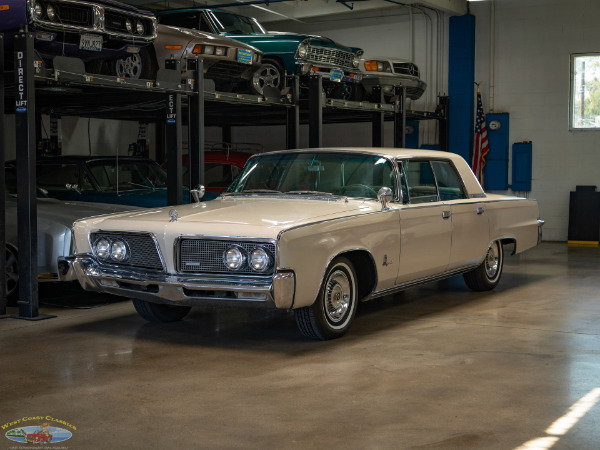
Chrysler Imperial
Introduced in 1926 as Chrysler Corporation’s flagship luxury model—and spun off into its own standalone luxury marque from 1955 through 1975 before returning in later revivals—the Chrysler Imperial stood toe-to-toe with Cadillac and Lincoln for decades. Built for executives, heads of state, and discerning drivers, classic Imperials combined hand-crafted coachwork, pioneering engineering, and unmistakable postwar American styling.
Production Numbers
Because the Imperial spanned multiple eras and shifted between a top-tier Chrysler model and an independent division, annual output remained noticeably more exclusive than its primary domestic rivals:
- Total Lifetime Production: Approximately 425,000 units across all production eras (1926–1975, 1981–1983, and 1990–1993).
- Pre-War & Early Post-War Low-Volume Years: Following World War II, output was strictly limited—740 units were built in 1947, 495 in 1948, and just 135 total Imperials (50 sedans and 85 Imperial Crown limousines) in 1949.
- Standalone Marque Era (1955–1975): Launching Imperial as an independent make boosted volume to 11,430 units in 1955. Output peaked during the mid-1960s, reaching 23,295 units in 1964 (its second-best model year) and 22,083 units in 1969. By the final year of the standalone marque in 1975, production tapered to 8,830 cars.
- Ultra-Rare Variants: Custom-bodied Crown Imperial limousines built by Ghia in Italy and 1974 50th Anniversary LeBaron Crown Coupes (only 57 produced) rank among the scarcest collector models.
Color Combinations
Chrysler offered an extensive palette of rich single-tone and two-tone exterior finishes paired with coordinated broadcloth, leather, and vinyl interiors:
- Signature Exterior Finishes: Classic factory colors included Formal Black, Polar White, Regal Red, Regent Ruby, Midnight Blue Metallic, Powdered Bronze Metallic, Silverpine Metallic, Sheffield Silver Iridescent, Tahitian Turquoise, and Golden Fawn.
- Roof & Accent Options: Two-tone paint schemes were popular during the 1950s, while 1960s and 1970s Crown and LeBaron models frequently featured full or canopy vinyl roofs in Formal Black, Antique White, Antique Green, or Chestnut.
- Interior Upholstery: Standard sedans combined heavy cloth and vinyl, whereas Crown and LeBaron trims featured supple leather, jacquard fabrics, and genuine 100-year-old Claro walnut wood veneers.
Engine Type
Across its classic run, the Imperial transitioned from smooth straight-eight powerplants to some of Detroit’s most celebrated V8 engines:
- 1926–1950 Straight-Eights: Early generations relied on torque-rich L-head inline-8 engines ranging from 273.8 cu in (4.5 L) and 323.5 cu in (5.3 L) Spitfire eights up to the massive 384.8 cu in (6.3 L) flathead straight-eight.
- 1951–1958 FirePower Hemi V8s: Chrysler revolutionized luxury performance in 1951 with the 331 cu in (5.4 L) hemispherical-chamber V8, later enlarged to the 354 cu in (5.8 L) Hemi in 1956 (280 hp) and the legendary 392 cu in (6.4 L) Hemi in 1957–1958 (up to 345–350 hp).
- 1959–1975 Wedge Big-Block V8s: In 1959, Chrysler replaced the Hemi with the lighter, higher-torque 413 cu in (6.8 L) “RB” Wedge V8 (340–350 hp), followed in 1966 by the powerhouse 440 cu in (7.2 L) V8.
Transmission
Imperial drivetrains prioritized effortless, seamless cruising:
- Pre-War Manuals & Fluid Drive: 1930s models utilized 3-speed and 4-speed manual transmissions (often with overdrive). By 1939, Chrysler introduced Fluid Drive, pairing a fluid coupling with a 3-speed manual or the 4-speed Presto-Matic semi-automatic transmission in the late 1940s and early 1950s.
- PowerFlite & TorqueFlite Automatics: Fully automatic shifting arrived in 1954 with the 2-speed PowerFlite, quickly succeeded in 1956 by the legendary 3-speed TorqueFlite (A488 and later A727). Notably, 1956–1964 Imperials controlled gear selection via iconic dashboard pushbuttons.
Additional Stats
- Body Styles: 2-door hardtop (Newport and Southampton), 2-door convertible, 4-door pillared sedan, 4-door hardtop, and long-wheelbase Crown Imperial limousine.
- Chassis & Layout: Front-engine, rear-wheel drive; body-on-frame construction persisted on Imperials through 1966 even after other Chrysler lines adopted unibody designs, switching to unibody construction in 1967.
- Dimensions & Weight: Wheelbases spanned 124 to 133 inches on standard models (and up to 149.5 inches on Crown limousines), with curb weights commonly exceeding 4,700 to 5,200 pounds. At 229.7 inches long in 1969—stretching to 235.3 inches by 1973—the Imperial held the title of longest non-limousine production car in America.
Detailed Car Description
The Chrysler Imperial represents the pinnacle of mid-century American automotive opulence and engineering confidence. Designed during its golden era by Virgil Exner—and later refined by Elwood Engel—the Imperial blended dramatic “Forward Look” tailfins, freestanding “gunsight” taillights, and imposing waterfall grilles with quiet, vault-like cabin comfort.
Inside, drivers were greeted by futuristic touches including electroluminescent “AstraDome” instrument clusters, swivel front seats, Auto-Pilot cruise control, and standard power assists.
On the open road, Chrysler’s Torsion-Aire suspension combined with massive Hemi or 413/440 Wedge V8 torque delivered an exceptionally smooth, commanding ride.
Because production numbers remained far lower than contemporary Cadillacs, well-preserved Chrysler Imperials—especially convertibles, two-door hardtops, and Ghia-built limousines—offer classic car collectors rare road presence and authentic luxury heritage.
Wondering if it’s time to sell your Chrysler Imperial?
Submit your vehicle details online today to get a fast, hassle-free valuation and sell your classic American car with confidence.