
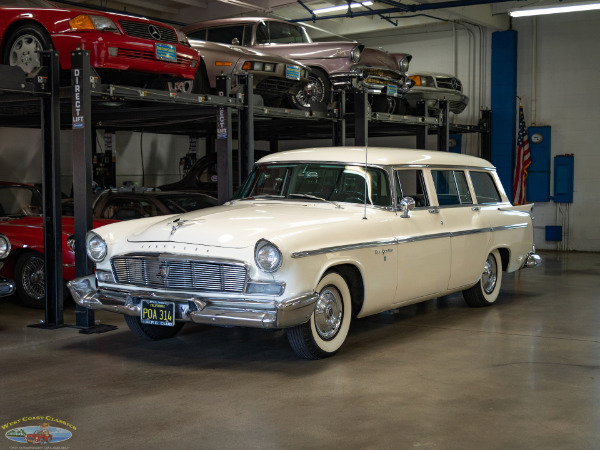
Chrysler New Yorker
Produced across 14 distinct generations from 1939 to 1996, the Chrysler New Yorker holds the distinction of being the longest-running American automotive nameplate. Originally introduced as the upscale “New York Special” trim in 1938 before becoming a standalone model the following year, it served as Chrysler’s flagship luxury offering for decades.
Positioned directly against upper-tier models from Buick, Oldsmobile, and Mercury, the New Yorker blended conservative prestige with major mechanical breakthroughs.
Production Numbers
Because the Chrysler New Yorker remained in continuous production for 57 years—halted only briefly during World War II—total production spans hundreds of thousands of units across diverse body styles, including two-door coupes, four-door sedans, pillarless hardtops, convertibles, and Town & Country station wagons.
While high-volume sedan years regularly exceeded 20,000 to 90,000 units (peaking at 98,172 U.S. sales in 1988), open-top and specialty models were built in sharply limited quantities that draw strong collector demand today:
- 1942 Series C36: 12,145 total units built before wartime production ceased.
- 1953 New Yorker DeLuxe Convertible: 950 units built (the most expensive model on the 125.5-inch chassis that year).
- 1956 New Yorker St. Regis Convertible: 921 units built.
- 1957–1958 “Forward Look” Convertibles: 1,049 built in 1957, dropping to just 666 convertibles in 1958.
- 1961 Total Production: 20,399 units, including just 576 convertibles and 676 station wagons.
- 1996 Final Model Year: Only 3,295 units produced before the nameplate was retired in favor of the Chrysler LHS.
Color Combinations
Over nearly six decades, Chrysler offered the New Yorker in era-defining exterior palettes paired with coordinated cloth, broadcloth, or leather interiors:
- 1940s–1950s Elegance & Two-Tones: Early post-war models featured stately solids like Black, dark blues, and maroons. By the mid-1950s, Chrysler embraced vibrant mid-century styling; the 1955–1956 New Yorker St. Regis hardtop notably offered nine optional three-tone paint combinations pairing pastel and metallic shades alongside matching two-tone leather cabins.
- 1960s–1970s Metallics: Classic 1960s palettes introduced shades such as Alaskan White, Polar Blue Poly, Sapphire Blue Poly, Willow Green, Silver Lilac Poly, Turbine Bronze Poly, and Scorch Red. In the 1970s, formal Brougham trims frequently paired metallic greens, golds, and deep reds with matching color-keyed vinyl tops.
- 1980s–1990s Luxury Finishes: Later front-wheel-drive generations shifted toward subdued executive tones, including Bright White, Black Crystal, Midnight Blue Metallic, Silver Quartz Metallic, Light Champagne Metallic, Driftwood Satin, and Black Cherry Metallic.
Engine Type
The New Yorker’s powertrain evolution mirrors the golden age of American engineering, transitioning from smooth pre-war inline engines to legendary V8 muscle and modern fuel-injected V6s:
- Spitfire Straight-Eight (1939–1950): Early models relied on Chrysler’s silky 323.5-cubic-inch (5.3L) L-head inline-eight producing 135 horsepower.
- FirePower Hemi V8 (1951–1958): In 1951, Chrysler revolutionized the luxury segment with the 331-cubic-inch (5.4L) FirePower hemispherical-head V8 rated at 180 horsepower. Displacement and output climbed rapidly to the 354-cubic-inch Hemi (280 hp in 1956) and the towering 392-cubic-inch Hemi, which delivered up to 345 horsepower by 1958.
- Golden Lion & RB Big-Block V8s (1959–1978): For 1959, Chrysler replaced the Hemi with the lighter, torque-rich 413-cubic-inch (6.8L) Golden Lion wedge-head V8 rated at 350 horsepower (with an optional 360-hp letter-car spec). From 1966 through 1978, the massive 440-cubic-inch (7.2L) RB V8 powered full-size New Yorkers, joined by 360- and 400-cubic-inch V8 options in the late 1970s.
- Downsized Inline-Six, V8 & V6 Engines (1979–1996): The 1979 R-body utilized the 225-cubic-inch Slant-Six and 318/360 V8s, while 1980s K-car derivatives introduced turbocharged 2.2L and 2.5L four-cylinders alongside Mitsubishi-sourced 3.0L V6s. The final cab-forward generation (1994–1996) featured a 3.5L 24-valve V6.
Transmission
- 1939–1953: Three-speed manual transmissions were paired with Chrysler’s innovative Fluid Drive coupling and the semi-automatic four-speed Presto-Matic gearbox, allowing clutchless cruising in traffic.
- 1954–1955: Chrysler introduced its first fully automatic transmission, the two-speed PowerFlite.
- 1956–1988: The legendary three-speed TorqueFlite automatic debuted in 1956—initially operated via dashboard push-buttons—and served as the backbone of rear-wheel-drive New Yorkers for decades.
- 1989–1996: Front-wheel-drive models transitioned to Chrysler’s four-speed Ultradrive electronic automatic transmission.
Additional Stats
- Drivetrain Layout: Rear-wheel drive from 1939 through 1981; front-wheel drive from 1982 through 1996.
- Wheelbase Range: Varied from an expansive 131.5 inches on early post-war sedans down to 122–126 inches during the 1960s and 1970s, and 103.3 inches on mid-1980s sedans.
- Period Performance: A 1951 FirePower Hemi New Yorker could accelerate from 0 to 60 mph in roughly 10 seconds—outpacing the contemporary Oldsmobile 88 Rocket.
- Original MSRP: A 1953 New Yorker DeLuxe Convertible listed at $3,980, while a fully equipped 1956 Town & Country Wagon commanded $4,523 (over $50,000 in modern purchasing power).
Detailed Car Description
The Chrysler New Yorker represents the quintessential American luxury cruiser, evolving seamlessly alongside mid-century design and engineering trends. Early post-war models from 1946 to 1954 stood out for their upright “chair-height” seating, unmistakable “harmonica” chrome grilles, and padded safety dashboards.
In 1955 and 1957, famed stylist Virgil Exner transformed the New Yorker with his “100-Million Dollar Look” and “Forward Look” designs—introducing sweeping tailfins, wraparound windshields, and available space-age novelties like the under-dash Highway Hi-Fi 16?-rpm record player and “Auto-Pilot” cruise control.
During the 1960s and 1970s, the New Yorker embraced crisp, architectural unibody styling, hidden headlamps on Brougham models, and cavernous, whisper-quiet interiors trimmed in plush velour or tufted leather.
Whether equipped with an early FirePower Hemi or a torque-laden 440 V8, classic New Yorkers remain prized by collectors for effortless highway manners, distinctive styling, and unmistakable presence.
Sell Your Chrysler New Yorker
If you own a vintage Chrysler New Yorker—from a 1950s Hemi-powered hardtop or convertible to a well-preserved 1960s or 1970s luxury cruiser—Sell a Classic Car makes the American car selling process straightforward and hassle-free.
Whether your vehicle is a show-ready collector piece, a long-term family survivor, or a garage find, our team offers fair market valuations, immediate payment, and nationwide enclosed transport directly from your location. Reach out through our online valuation form today to receive a no-obligation cash offer for your classic Chrysler New Yorker.