
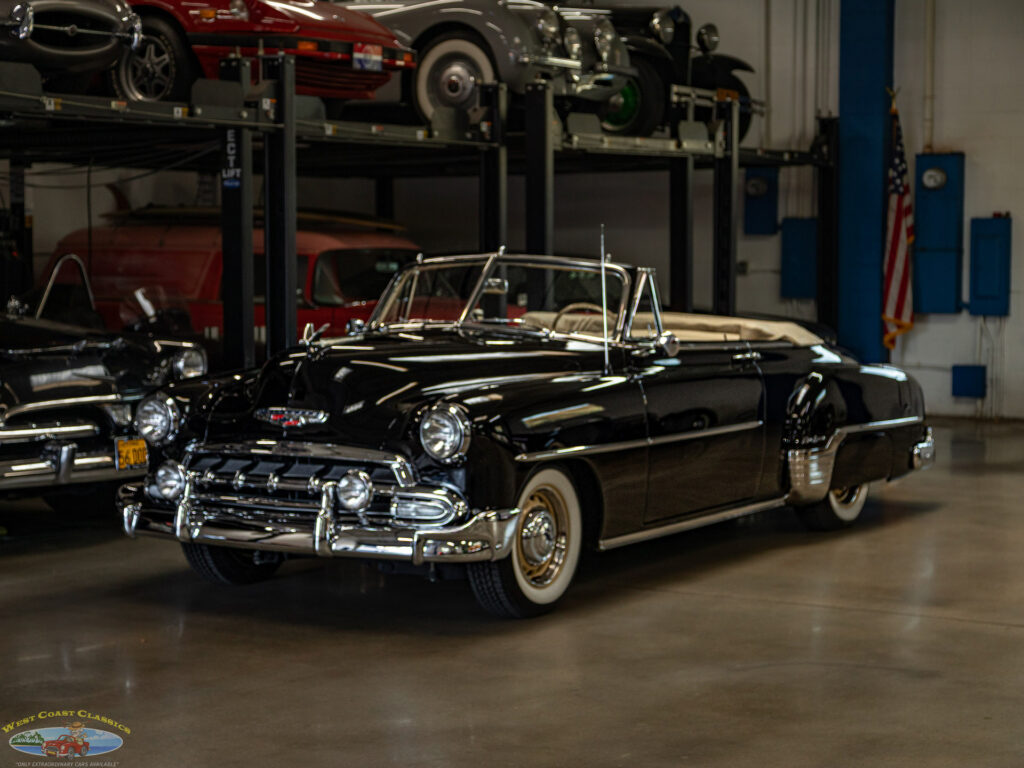
The Chevrolet Bel Air made its debut in 1950 as a standalone upscale hardtop coupe. By offering a sleek pillarless roofline paired with upscale brightwork at a Chevrolet price point, it brought convertible-like glamour and luxury to mainstream buyers.
In 1953, Chevrolet promoted the Bel Air badge from a single body style to its premier, top-tier model series. The car offered sedans, hardtop sport coupes, convertibles, and wagons, all boasting rich appointments such as deluxe carpeting, full chrome window frames, distinctive script badges, and two-tone paint treatments.
The pinnacle of Bel Air prestige arrived with the 1955–1957 generation:
- 1955 (“The Hot One”): Introduced a modern, slab-sided body design with an egg-crate grille inspired by contemporary European sports cars, accompanied by the revolutionary small-block V8.
- 1956: Received a broader front grille, refined side sweeps, hidden gas filler behind the taillight, and standard seatbelt options.
- 1957: Achieved pop-culture immortality with sweeping tailfins, dual windsplit hood ornaments, anodized gold accents, and the groundbreaking Ramjet fuel-injected V8.
Through the 1960s and 1970s, the Bel Air evolved through full-size platforms alongside the Biscayne and Impala, remaining a fixture on American highways as a dependable, spacious cruiser before concluding its domestic run in 1975.
Production Numbers
Across its multi-decade run, millions of Bel Air units rolled off assembly lines across North America. The most sought-after collector models belong to the 1955–1957 production cycles:
- 1955 Bel Air Lineup: ~790,968 total units produced
- 4-Door Sedan: 366,293
- 2-Door Hardtop Sport Coupe: 189,269
- 2-Door Sedan: 168,826
- 2-Door Convertible: 42,278
- 4-Door Beauville Station Wagon: 25,772
- 2-Door Nomad Station Wagon: 8,530
- 1956 Bel Air Lineup: ~692,490 total units produced
- 4-Door Sedan: 282,476
- 2-Door Hardtop Sport Coupe: 130,778
- 4-Door Hardtop Sport Sedan: 109,261
- 2-Door Sedan: 105,098
- 2-Door Convertible: 41,883
- 4-Door Townsman Wagon: 14,931
- 2-Door Nomad Wagon: 8,103
- 1957 Bel Air Lineup: ~716,356 total units produced
- 4-Door Sedan: 264,449
- 2-Door Hardtop Sport Coupe: 168,293
- 4-Door Hardtop Sport Sedan: 142,518
- 2-Door Sedan: 62,942
- 2-Door Convertible: 48,068
- 4-Door Townsman Wagon: 27,822
- 2-Door Nomad Wagon: 6,264

Color Combinations
Chevrolet made bold use of automotive color styling during the 1950s and 1960s, offering vivid single-tone and striking two-tone exterior finishes paired with color-keyed vinyl and patterned cloth interiors.
- Popular Exterior Finishes: Tropical Turquoise, Matador Red, India Ivory, Onyx Black, Larkspur Blue, Harbor Blue, Sierra Gold, Dusk Rose, Adobe Beige, Highland Green, and Surf Green.
- Two-Tone Schemes: Commonly matched an India Ivory or contrasting roof/body insert with vibrant primary shades, such as Tropical Turquoise & India Ivory, Matador Red & India Ivory, or Dusk Rose & India Ivory.
- Interior Trims: Coordinated two-tone upholstery featuring vinyl bolsters with patterned gabardine cloth, waffle-weave vinyl, or silver/gold-threaded accents designed to echo the exterior paint.
Engine Type
Throughout its lifespan, the Bel Air featured both dependable six-cylinder engines and landmark V8 powerplants:
- Inline-6 “Stovebolt” & “Blue Flame”:
- 216.5 cu in (3.5L) OHV I6 (early 1950–1952)
- 235.5 cu in (3.9L) OHV I6 (1953–1962), rated between 115 hp and 140 hp depending on year and induction
- Small-Block V8:
- 265 cu in (4.3L) Turbo-Fire V8 (1955–1956): Delivered 162 hp (2-barrel carburetor), 180 hp (Power Pack 4-barrel), and up to 225 hp with dual 4-barrel carburetors.
- 283 cu in (4.6L) Turbo-Fire V8 (1957+): Delivered 185 hp base up to 283 hp with the Rochester Ramjet mechanical fuel injection system (“one horsepower per cubic inch”).
- Later Big-Block & Small-Block Additions: Expanded in subsequent generations to include the 348 “W-head,” 327, 396, and 409 cu in V8s.
Transmission
Buyers could equip the Bel Air with manual or automatic configurations tailored for cruising or performance:
- 3-Speed Manual: Column-shifted standard gearbox.
- 3-Speed Manual with Overdrive: Added an electric overdrive unit for lower highway engine speeds and improved cruising fuel efficiency.
- 2-Speed Powerglide Automatic: A durable, widely chosen two-speed torque-converter automatic.
- Turboglide Automatic (1957+): A continuously variable, triple-turbine automatic offering seamless step-less shifting.
- 4-Speed Manual & 3-Speed Turbo Hydra-Matic: Added in later generations for performance-oriented and heavy-duty drivetrain pairings.
Additional Stats
- Wheelbase: 115.0 inches (1950–1957 models); expanded to 117.5 inches in 1958 and 119.0 inches in 1959.
- Overall Length: 195.6 inches (1955) to 200.0 inches (1957).
- Curb Weight: Approximately 3,200 to 3,550 lbs depending on body style, options, and engine package.
- Suspension: Independent front coil springs with unequal-length A-arms; live rear axle on semi-elliptic leaf springs.
- Brakes: 11-inch hydraulic four-wheel drum brakes (optional power assist available from 1954 onward).
- Chassis Layout: Front-engine, rear-wheel drive (FR layout).
Ready to Sell Your Classic Chevrolet Bel Air?
If you have a vintage Chevrolet Bel Air in your garage, collection, or estate, finding the right buyer who appreciates its heritage shouldn’t be stressful. Whether your car is a pristine show-winner, an untouched original, or an unfinished restoration project, Sell A Classic Car makes the transaction seamless, secure, and hassle-free.
Submit your car’s details and photos through our online valuation form today to receive a fair, prompt cash offer and complimentary nationwide pickup.