Cadillac Eldorado Seville
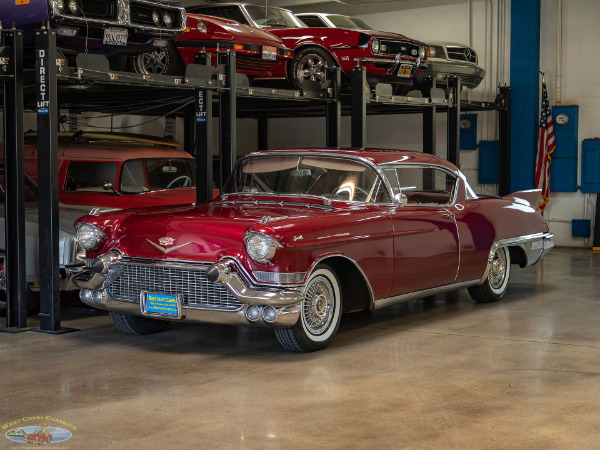
Produced exclusively from 1956 through 1960, the Cadillac Eldorado Seville represents the pinnacle of mid-century American personal luxury. Introduced alongside the open-top Eldorado Biarritz, the Seville served as Cadillac’s flagship two-door pillarless hardtop coupe. Blending coachbuilt details, advanced V8 performance, and dramatic Harley Earl and Chuck Jordan styling, the Eldorado Seville remains one of the most sought-after collectible Cadillacs of the 1950s.
Production Numbers
Cadillac kept Eldorado Seville production strictly limited across its five-year run, making every model year rare by postwar domestic standards:
- 1956: 2,150 units
- 1957: 2,100 units (2,104 including four experimental 4-door hardtop prototypes)
- 1958: 855 units (lowest production year)
- 1959: 975 units
- 1960: 1,075 units
Total 1956–1960 Production: 7,155 standard two-door hardtop coupes.
Color Combinations
Because the Eldorado Seville sat at the very top of Cadillac’s lineup, buyers had access to exclusive exterior palettes, distinctive roof treatments, and upscale interior trims not offered on standard Series 62 models:
- Exterior Finishes: Offered in up to 15 standard Cadillac colors alongside 5 Eldorado-exclusive metallic and pastel hues, including signature shades such as Olympic White, Ebony Black, Chantilly Maroon, Pacific Coral, Copper, and metallic greens and blues.
- Roof Treatments: Early 1956 models pioneered padded Vicodec vinyl roof coverings—available in white, black, light blue, beige, and light green—creating a bespoke two-tone contrast with the lower body.
- Interior Combinations: Cabins were trimmed in supple full-grain leather or a combination of Florentine-pattern metallic nylon cloth paired with white leather bolsters. Matching or contrasting leather interiors came in black, white, blue, green, red, and metallic tones, with optional front bucket seats appearing on late-run 1959 and 1960 cars.
Engine Type
Every Cadillac Eldorado Seville was powered by an overhead-valve (OHV) cast-iron V8 engineered for effortless highway torque and smooth, quiet acceleration:
- 1956–1958 (365 cu. in. / 6.0-liter V8): Rated at 305 horsepower in 1956 with dual four-barrel carburetors (with a 325-horsepower option), rising to 325 horsepower in 1957 and 335 horsepower in 1958 via high-output triple two-barrel (“Tri-Power”) carburetion.
- 1959–1960 (390 cu. in. / 6.4-liter V8): Bore and stroke expanded to 4.00 x 3.875 inches with a 10.5:1 compression ratio. Equipped with three Rochester two-barrel carburetors, this engine produced 345 horsepower at 4,800 rpm and 435 lb-ft of torque at 3,400 rpm.
Transmission
- Gearbox: 4-speed Jetaway / Controlled-Coupling Hydra-Matic automatic transmission (standard across all model years, 1956–1960).
- Drivetrain: Front-engine, rear-wheel drive.
Additional Stats
- Body Style: 2-door, 6-passenger pillarless hardtop coupe
- Wheelbase: 129.5 inches (1956–1958); 130.0 inches (1959–1960)
- Overall Length: 222.1 inches (1957) to 225.0 inches (1959–1960)
- Curb Weight: Approximately 4,855 to 5,200 lbs depending on year and equipment
- Original Base Price: $6,556 (1956) climbing to 7,401–7,410 (1958–1960)—roughly double the cost of an entry-level Cadillac
- Performance (1959–1960 390 V8): 0–60 mph in approximately 10.8 seconds, quarter-mile in 17.9 seconds at 83 mph, and a top speed near 126 mph
- Standard Luxury Equipment: Power steering, power brakes, power windows, 6-way power seat, Autronic-Eye automatic headlamp dimmer, signal-seeking Wonderbar radio, cast-aluminum “Sabre-Spoke” wheels (1956–1958), and optional air suspension (1958–1960).
Detailed Car Description
When Cadillac introduced the Eldorado Seville for the 1956 model year, the goal was to offer buyers all the prestige, exclusivity, and visual drama of the open-air Eldorado Biarritz in an all-weather, fixed-roof hardtop. Designed under General Motors styling chief Harley Earl—and later refined by Chuck Jordan—the Seville evolved rapidly across five distinct model years.
Early 1956 Sevilles stood apart from standard Cadillacs with twin hood-mounted windsplit fins in place of the traditional flying goddess mascot, gold script badging, ribbed chrome door saddles, and distinctive Vicodec padded vinyl roofs.
For 1957 and 1958, Cadillac introduced a tubular X-frame chassis that lowered the roofline while giving the Seville sculpted rear quarter panels and inward-canted “shark” tailfins. The 1958 model—with just 855 built—added quad headlights, jeweled grille textures, and vertical fender louvers.
The 1959 Eldorado Seville remains an icon of 1950s Jet Age automotive design. Stretching 225 inches on a 130-inch wheelbase, it boasted the tallest tailfins ever fitted to a production automobile, accented by twin bullet taillights and sweeping stainless-steel body moldings.
For its final year in 1960, Cadillac toned down the fins into sleeker, cleaner blades while retaining the potent 345-horsepower Tri-Power 390 V8. After 1960, Cadillac retired the Eldorado Seville coupe, leaving behind a five-year run of low-production, hand-finished luxury flagships prized by collectors worldwide.
Ready to Sell Your Cadillac Eldorado Seville?
Whether you own a concours-restored 1959 Eldorado Seville or an untouched barn-find project, getting a fair valuation starts with specialists who understand rare 1950s American luxury cars. Submit your vehicle details on our website today for a fast, no-obligation offer and hassle-free nationwide pickup.