

Cord
Few American marques capture the daring spirit of 1930s automotive design and engineering quite like the Cord. Manufactured by the Auburn Automobile Company in Connersville, Indiana, between 1929 and 1932, and again from 1936 to 1937, Cord built a reputation on radical mechanical innovation and Art Deco styling.
Founded by visionary industrialist Errett Lobban (E.L.) Cord, the brand bridged the gap between Auburn and Duesenberg, creating some of the most recognizable—and collectible—prewar classics in existence.
Production Numbers:
Cord automobiles were built in remarkably low volumes, contributing heavily to their desirability among collectors today. Across its brief two-era lifespan, total Cord production reached roughly 7,300 to 8,000 units across all models:
- Cord L-29 (1929–1932): Approximately 4,400 to 5,010 units were produced before the deepening Great Depression forced a temporary halt to the brand.
- Cord 810 (1936): Only 1,174 units were built during the model’s debut year due to early manufacturing delays.
- Cord 812 (1937): Roughly 1,798 units rolled off the assembly line in the marque’s final production year. Out of the entire 810/812 run, only a fraction were factory-equipped with a supercharger—an estimated 134 supercharged Cord 812 models are believed to survive today.
- 1938 Prototype: A single 1938 Cord prototype featuring minor grille and transmission cover updates was constructed before the company’s closure.
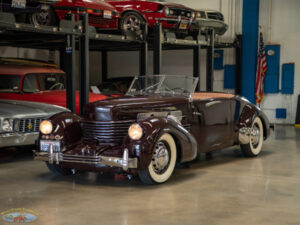
Color Combinations:
Factory color palettes for Cord automobiles reflected the luxury tastes of the late 1920s and the Streamline Moderne movement of the mid-1930s.
- Cord L-29: Offered in classic, stately two-tone and monotone schemes typical of the Roaring Twenties and early 1930s, pairing deep maroons, dark blues, blacks, and forest greens with contrasting fender accents and richly appointed broadcloth or leather cabins.
- Cord 810 & 812: Designed to accentuate Gordon Buehrig’s sculptural bodywork, official factory finishes included Cigarette Cream, Cadet Gray, Geneva Blue, Palm Beach Tan, Rich Maroon (also known as Toga Maroon), Orchard Green, Nassau Orange, and Vermillion Red. Exterior colors were commonly paired with high-contrast leather interiors in red, tan, blue, or black, or refined broadcloth upholstery on closed sedans.
Engine Type:
Every production Cord was powered by an inline or V8 engine supplied by Lycoming, a sister company within E.L. Cord’s automotive empire:
- Cord L-29: Powered by a 298.6-cubic-inch (4.9-liter) Lycoming L-head straight-eight engine producing 125 horsepower at 3,600 rpm.
- Cord 810 & 812 (Naturally Aspirated): Equipped with a newly engineered 288.6-cubic-inch (4.7-liter) Lycoming FB L-head V8 delivering 125 horsepower at 3,500 rpm.
- Cord 812 Supercharged (S/C): Offered with a Schwitzer-Cummins centrifugal supercharger bolted to the 288.6-cubic-inch V8, boosting output to 170 horsepower at 4,200 rpm. Supercharged models are easily identified by their signature chrome external exhaust pipes emerging from both sides of the hood.
Transmission:
Cord’s powertrain layouts were pioneering for American production cars, placing the transmission ahead of the engine to drive the front wheels:
- Cord L-29: Utilized a 3-speed selective sliding-gear manual transmission paired with a front-wheel-drive transaxle and Cardan constant-velocity universal joints.
- Cord 810 & 812: Featured an innovative 4-speed Bendix electro-vacuum pre-selector semi-automatic transmission. Rather than using a traditional floor-mounted shift lever, drivers selected their next gear via a small finger-tip gate mounted on the steering column; depressing the clutch pedal engaged the pre-selected gear via vacuum power.
Additional Stats:
- Drivetrain Layout: Front-engine, front-wheel drive (Cord was the first American automaker to offer front-wheel drive to the public).
- Wheelbase: 137.5 inches (L-29); 125 inches (standard 810/812) and 132 inches (810/812 Custom Beverly and Berline).
- Curb Weight: Roughly 4,500 lbs (L-29); 3,680 to 4,110 lbs depending on body style (810/812).
- Top Speed: Approximately 75–78 mph (L-29); over 90 mph (standard 810/812) and exceeding 100 mph (812 Supercharged).
- Brakes & Suspension: Four-wheel hydraulic drum brakes across all generations. The 810/812 introduced independent trailing-arm front suspension with a transverse semi-elliptic leaf spring.
- Original MSRP: Approximately $3,095 to $3,295 (1929 L-29); $1,995 to $2,645+ (1936–1937 810/812).
Detailed Car Description:
Cord’s place in automotive history rests on two distinct, groundbreaking eras. When the Cord L-29 debuted in 1929, its front-wheel-drive architecture eliminated the driveshaft tunnel, allowing coachbuilders and factory stylists to drop the roofline dramatically lower than contemporary rear-wheel-drive Packards, Cadillacs, and Lincolns. While its long hood and low stance made it an instant styling sensation, the L-29 was heavy and arrived just months before the Wall Street Crash, limiting its commercial run.
Following a three-year hiatus, Cord stunned the automotive world at the November 1935 New York Auto Show with the Model 810, styled by legendary designer Gordon M. Buehrig.
Nicknamed the “Coffin Nose,” the 810—and its 1937 successor, the Model 812—abandoned traditional upright radiator grilles in favor of wraparound horizontal louvers, pontoon fenders, concealed door hinges, a step-down all-steel body with no running boards, and the industry’s first retractable headlights, operated via hand cranks on the dashboard.
Available in Westchester and Beverly sedans, two-seat Sportsman cabriolets, and four-seat Phaeton convertibles, the 810/812 looked decades ahead of its peers. In 1951, New York’s Museum of Modern Art honored the Cord 810/812 as one of the ten most significant automobile designs of all time.
Today, CCCA Full Classic status, low survival rates, and unmatched Art Deco pedigree make original Cords centerpiece acquisitions in major private collections and concours events worldwide.
Ready to Sell Your Classic Cord?
Whether you own a prewar Cord L-29 or an iconic “Coffin Nose” 810 or 812, finding the right buyer requires a team that understands the true collector value of classic American cars. Submit your vehicle details through our online appraisal form today for a fast, fair, and hassle-free offer on your classic car.